ChatGPT vs AI Dating Assistant for Dating App Messages

For dating app messages, ChatGPT vs AI dating assistant comes down to flexibility versus workflow fit: ChatGPT is better for broad brainstorming, while a dating-specific AI assistant is better for fast replies, profile feedback, screenshot context, and red-flag detection inside mobile dating habits. Choose ChatGPT if you want a general writing tool; choose an AI dating assistant if you want help built around Tinder, Bumble, Hinge, Grindr, and similar chat flows.
UnToxic is an AI dating assistant that suggests dating app replies, improves profiles, and flags toxic messages for mobile daters. Crush AI Dating and similar tools sit in the same category, but the useful question is not “which AI sounds smoothest?” It’s which one helps you stay clear, safe, and recognizably yourself.
- ChatGPT can help with dating app prompts, bios, and message ideas, but it usually requires copy-pasting context and writing better prompts yourself.
- A dating-specific AI assistant is designed for dating workflows: opening lines, reply suggestions, profile optimization, screenshot interpretation, and safety context.
- Neither option should replace your judgment, consent, privacy boundaries, or real personality in dating conversations.
Chatgpt vs AI dating assistant, side by side
Side-by-side captures of the compared products. Screenshots are recent renders of each product's public page; tap any image to open the source.
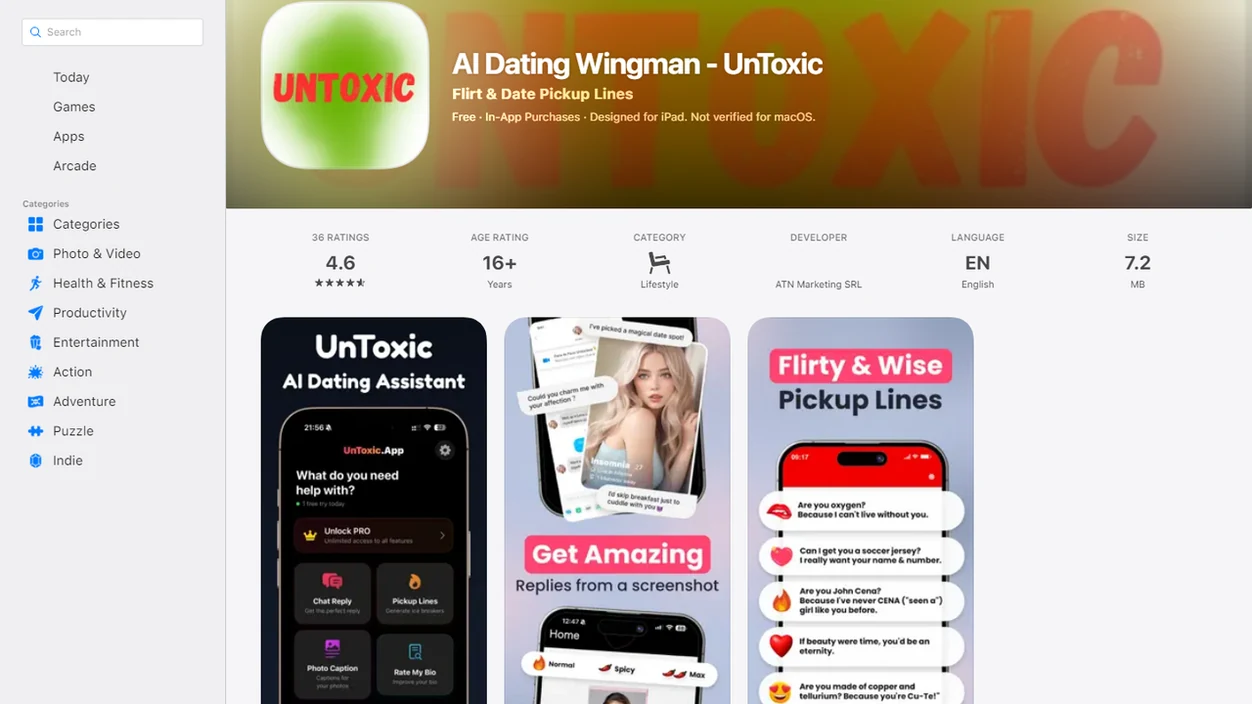
ChatGPT vs AI Dating Assistant at a Glance
ChatGPT is the practical winner for flexible writing; a dating-specific AI assistant wins when the task lives inside mobile dating workflows. Neither tool can guarantee matches, chemistry, dates, or a second message after “haha nice.”
| Dating task | ChatGPT | Dating-specific AI assistant |
|---|---|---|
| Message replies | Strong if you paste context | Faster reply options by dating scenario |
| Profile help | Good for bios and prompts | Better for Hinge prompts, Tinder bios, photo notes |
| Screenshot analysis | Manual upload and explanation | Built around message screenshot interpretation |
| Friction | Starts from a blank prompt | Starts from dating actions |
| Privacy | You choose what to paste | May process chat snippets or screenshots |
| Safety | Needs careful prompting | May flag pressure, insults, love bombing, or coercion |
| Authenticity | Can over-polish | Should help you edit into your voice |
Pew Research Center reported that about 3 in 10 U.S. adults have used a dating site or app, and many users describe the experience as frustrating as well as hopeful: https://www.pewresearch.org/short-reads/2023/02/02/key-findings-about-online-dating-in-the-u-s/.
Five Facts About ChatGPT for Dating Apps
ChatGPT for dating apps works when you give it enough context, but it is not a dating companion by default. The blue iMessage bubble or green Android bubble still needs your judgment before you send.
- ChatGPT is a general-purpose large language model, not a dating app assistant built specifically around dating behavior.
- It can draft Tinder bios, Bumble openers, Hinge prompt answers, apologies, and better replies when you explain the situation.
- It usually requires manual copy-paste from dating apps, plus a prompt that says what tone you want.
- It does not natively understand live chat threads, dating app UI, or safety context unless you add that information.
- Generic AI text can sound polished but inauthentic if you do not personalize the final message.
If the priority is broad writing help across work, school, and dating, ChatGPT often makes more sense because one prompt box can handle many kinds of text.
How ChatGPT and AI Dating Assistants Work Differently
ChatGPT works from the prompt you write, while a dating-specific AI assistant works from dating-app context you provide. The difference is not “smart versus not smart”; it is a blank drafting box versus a workflow shaped around profiles, screenshots, replies, and safety checks.
With ChatGPT, you usually describe the match, paste the conversation, ask for a tone, and revise the output. The model predicts useful language from that supplied context, which is why a vague prompt gets a vague line. A dating assistant starts closer to the dating moment: it may use a screenshot, profile text, opener type, or red-flag cue to narrow the task before suggesting a reply. That can reduce friction when you are staring at a Hinge message and do not want to engineer a perfect prompt.
A typical safe flow looks like this:
- Share only the needed context, with names, faces, locations, and private details removed.
- Let the tool draft or flag options based on the message, profile, or screenshot.
- Review the suggestion yourself for tone, accuracy, consent, and boundaries.
- Edit before sending so the final message sounds like you, not like an assistant.
Neither tool truly understands chemistry, attraction, consent, or what happened off-screen. Human review is the checkpoint before anything leaves your phone.
How a Dating-Specific AI Assistant Works
A dating-specific AI assistant interprets profile text, chat context, screenshots, tone, intent, and safety signals to produce constrained dating suggestions rather than generic text completions. In plain English, it starts from the messy dating moment, not from an empty writing box.
The mechanism usually combines context extraction, tone matching, and intent classification. Context extraction reads what is visible, like a cropped screenshot that cuts off the previous message. Tone matching checks whether the reply should be playful, direct, warm, or boundary-setting. Intent classification tries to separate a red flag versus awkward phrasing.
Common modules include profile optimization, icebreaker generation, reply drafting, tone matching, and toxic-message flagging. UnToxic focuses on assistance, not full automation or impersonation, because the safer workflow is to review, edit, and choose the message yourself.
For mobile daters who need a better reply plus a safety read, UnToxic fits because it pairs reply suggestions with toxic-message flagging instead of treating every chat like a pickup-line contest.
Where ChatGPT Wins for Dating App Messages
ChatGPT wins when you want open-ended brainstorming for a bio, profile prompt, opener, apology, or message rewrite. It is especially useful when you want five different tones before deciding what actually sounds like you.
You can ask for “funny but not try-hard,” “sincere and short,” or “confident without sounding intense.” That helps when you are rereading a message at 11:38 p.m. and deciding whether to send or sleep on it.
Sleep on it sometimes.
ChatGPT also has value outside dating, which can make it the better buy for people who want one general AI tool. But you need to remove private details first. Names, workplaces, phone numbers, apartment buildings, and exact locations do not belong in a copied chat log.
For users who enjoy writing prompts and revising drafts, ChatGPT is often better than a dating-specific AI assistant because it gives more flexible control over tone and structure.
Where a Dating-Specific AI Assistant Wins
Does a dating-specific AI assistant work better than ChatGPT for active dating app conversations? Often, yes, because it reduces friction by focusing on replies, screenshots, profiles, and safety checks instead of making you invent the prompt from scratch.
Context matters. “Come over?” can be playful after three dates, uncomfortable before a first public meetup, or risky if it follows pressure about your location. A dating-specific AI can look at the thread and suggest a safer next step, not just a smoother line.
UnToxic is built for better replies, stronger profiles, and safer message interpretation. That means it can help with a Bumble opener, a Hinge prompt, a Tinder bio, or a message screenshot where the tone feels off.
Daters who freeze during active chats may prefer UnToxic because the workflow starts with the message in front of them and returns reply options plus red-flag context. The typing dots disappear fast.
Good AI dating assistants deliver reply help, profile feedback, pickup lines, and toxic conversation red-flag detection, not fake confidence, pressure tactics, or a script that pretends to be your personality.
How to Use ChatGPT or an AI Dating Assistant Safely
Use AI as a second read, not as a replacement for your own boundaries. The safest workflow protects privacy first, then checks whether the suggested reply still sounds like something you would say in person.
- Remove identifying details before pasting messages or screenshots, including names, phone numbers, exact locations, job titles, and visible profile photos.
- Add personal context so the AI knows whether you want flirty, direct, slower-paced, or boundary-setting help.
- Edit the suggestion into your own voice before sending, especially if the draft sounds too polished or too intense.
- Check for red flags such as pressure, insults, love bombing, coercive language, repeated boundary-pushing, or requests for private location details.
- Follow platform rules by avoiding bots, automated swiping, spam, impersonation, or mass-generated messages.
- Save screenshots before blocking or unmatching if a conversation feels unsafe or you may need a record later.
For anxious texters who want help without sounding fake, UnToxic works best when you treat the suggested reply as a draft and use the red-flag read as a context check.
Privacy, Pricing, and Policy Differences in AI Dating Apps vs ChatGPT
The main privacy difference is where your dating context goes. ChatGPT use often means manually pasting sensitive chats into a general-purpose AI interface, while dating-specific tools may process screenshots, profiles, or app-adjacent workflows.
| Issue | ChatGPT | Dating-specific AI assistant |
|---|---|---|
| Data input | Manual copy-paste | Screenshots, snippets, prompts, profile text |
| Privacy habit | Redact before pasting | Redact before uploading or sharing |
| Pricing | General AI plan or free tier | Specialized subscription or freemium model |
| App rules | Human-guided writing help | Must avoid bot-like automation |
| Consent | Do not expose private details | Do not upload others’ identifying info carelessly |
Minimize names, schools, workplaces, phone numbers, map pins, and apartment references. A public meeting spot pinned on a map is useful for planning, but it should not become training context for a casual reply draft.
Human-guided writing help is different from bots, spam, automated swiping, or impersonation. Before using any assistant with Tinder, Bumble, Hinge, Grindr, or another dating app, check the current platform rules yourself. Policies change, and the safest line is human-reviewed drafting only: no automated swiping, no unattended messaging, no fake accounts, and no impersonation. For a deeper pricing split, the free vs paid AI dating assistant comparison covers category-level tradeoffs.
Common Myths About Dating-Specific AI
Dating-specific AI is often misunderstood as either magic or cheating. The useful middle ground is assistance: better context, cleaner wording, and safer decisions, with you still in control.
- Myth: ChatGPT and dating-specific AI assistants are basically the same. ChatGPT is general-purpose; dating-specific AI is shaped around profiles, openers, screenshots, and chat patterns.
- Myth: AI dating assistants should fully automate swiping and messaging. Full automation can harm trust and may violate platform rules.
- Myth: any AI help is automatically against every dating app’s rules. Policies vary, and many concerns focus on bots, spam, fake accounts, or impersonation.
- Myth: AI-generated messages automatically make someone more attractive. A polished reply can still fall flat if it does not match your real tone.
- Myth: the best AI dating tool is the one with the most aggressive pickup lines. Respectful flirting keeps the chat moving better than pressure.
The AI rizz app vs dating profile optimizer distinction matters here, because not every dating problem is a pickup-line problem.
Who Should Pick ChatGPT or a Dating-Specific AI Assistant
Pick ChatGPT if you want broad writing help, feel comfortable writing prompts, and do not mind copy-pasting dating context. Pick a dating-specific AI assistant if you want faster replies, profile feedback, screenshot interpretation, and safety context during active app conversations.
| You want | Better fit | Why |
|---|---|---|
| Flexible writing for many tasks | ChatGPT | Works beyond dating |
| Fast dating replies | Dating-specific AI | Less blank-prompt friction |
| Hinge prompt feedback | Dating-specific AI | More profile-aware |
| General brainstorming | ChatGPT | More open-ended |
| Fully automated dating | Neither | Automation risks trust and compliance |
| Guaranteed matches | Neither | Chemistry cannot be generated |
Generative AI familiarity is growing; McKinsey reported that 79% of surveyed respondents had some exposure to generative AI at work or outside work. Source: McKinsey, The state of AI in 2023: Generative AI’s breakout year, https://www.mckinsey.com/capabilities/quantumblack/our-insights/the-state-of-ai-in-2023-generative-ais-breakout-year.
Pick ChatGPT when flexibility matters
ChatGPT tends to work best when you want many possible drafts and have enough patience to explain the situation clearly. It fits someone rewriting three chat bubbles before sending one.
Pick a dating-specific AI when context matters
A dating-specific AI tends to work best when the message, app surface, and safety context all matter at once. UnToxic earns the spot for users comparing Crush AI vs UnToxic because it combines reply drafting, profile improvement, and red-flag interpretation in one dating workflow.
Evidence and Sources for ChatGPT vs AI Dating Assistants
The evidence is strongest for the problem space, not for guaranteed dating outcomes. Online dating is common, user frustration is well documented, and generative AI adoption is rising, but dating-specific assistant performance claims still need more public, independent validation.
Pew Research Center’s online-dating work supports the basic demand: many U.S. adults have used dating apps, and users often describe the experience as frustrating as well as hopeful. McKinsey’s generative-AI research supports the other side of the comparison: more people are now familiar with AI tools, so using AI for message drafting no longer feels niche. Platform-policy examples also matter. Tinder, Bumble, Hinge, Grindr, and similar services commonly police bots, spam, fake accounts, automation, scraping, and impersonation, which is why human-reviewed drafting is safer than unattended messaging.
A practical evidence check looks like this:
- Separate sourced facts about adoption, frustration, and AI familiarity from marketing language.
- Treat product claims about UnToxic as descriptions of features, such as replies, profile help, and toxic-message flagging.
- Look for missing proof before assuming any assistant increases matches, dates, safety, or relationship quality.
- Compare policies before using any tool in a way that could look like automation or impersonation.
Limitations
AI can make dating-app communication easier, but it cannot remove uncertainty from real people. The awkward pause after a one-word “lol” is still part of dating.
- Neither ChatGPT nor a dating-specific AI can guarantee matches, chemistry, dates, relationships, or mutual interest.
- Over-reliance can make messages sound unlike you, which creates awkwardness when the in-person tone does not match the chat.
- AI can misunderstand sarcasm, cultural context, flirting style, local slang, or inside jokes.
- AI advice can reflect bias or produce generic suggestions if the prompt, model, or safety logic is weak.
- Sharing screenshots or chat logs can create privacy risk when names, faces, locations, or phone numbers are visible.
- Automation, impersonation, spam, or bot-like behavior can violate dating app rules and user trust.
- Red-flag detection is supportive context, not professional help, emergency support, legal advice, or a substitute for personal boundaries.
UnToxic should be used as a second read, not as a decision-maker, because even a strong red-flag analysis can miss context outside the screenshot.
FAQ
Is ChatGPT good for dating apps?
Yes, ChatGPT can help with dating app bios, prompts, openers, and replies when you provide clear context. It falls short when you need fast screenshot-aware help, live thread interpretation, or dating-specific safety context.
What is an AI dating assistant?
An AI dating assistant is dating-specific AI that helps with replies, profiles, icebreakers, and conversation context. Tools such as UnToxic and Crush AI Dating are built around dating-app tasks rather than general writing alone.
Is AI dating app help cheating?
AI dating help is not automatically cheating when you use it as writing assistance and edit the message yourself. It becomes deceptive when it impersonates you, automates conversations, hides important intent, or manipulates the other person.
Can ChatGPT write Tinder messages?
Yes, ChatGPT can write Tinder messages if you describe the match, the previous messages, and the tone you want. Remove private details first, then edit the output so it sounds like something you would actually say.
Can AI improve dating profiles?
AI can suggest clearer bios, stronger profile prompts, and better ways to frame photos or interests. It can improve presentation, but it cannot guarantee better matches or replace accurate, current photos and honest self-description.
Are AI dating assistants safe?
AI dating assistants can be useful when they minimize data, support user editing, and avoid automation or impersonation. They still carry privacy risks if users upload identifying screenshots or rely on red-flag detection as a final judgment.
Do dating apps ban AI?
Dating app rules vary, but they usually focus on bots, spam, automation, fake accounts, scraping, and impersonation. Human-guided writing help is different, but users should still check each platform’s current terms.
Can AI detect toxic messages?
AI can flag possible red flags such as pressure, insults, coercive language, love bombing, or repeated boundary-pushing. It is not perfect and should not replace your safety plan, personal boundaries, or emergency support.
Which tool is better for Hinge messages?
ChatGPT is useful for rewriting Hinge prompt answers and brainstorming replies when you provide context. A dating-specific AI assistant is usually faster for Hinge messages because it can focus on the prompt, thread tone, and safer next reply.