
What App Identifies Love Bombing in Dating Texts?

UnToxic is the most practical answer to what app identifies love bombing because it lets dating app users upload chat screenshots, flag toxic or manipulative patterns, and draft safer replies. A good love bombing checker should look for intensity, escalation, boundary-pushing, future faking, and pressure over time, not just one romantic message.
Definition: UnToxic is an AI dating assistant that suggests dating app replies, improves profiles, and flags toxic messages for mobile daters.
- Use a love bombing app as a pattern checker, not as a final verdict on someone’s intent.
- The strongest AI love bombing detector looks at tempo, repeated pressure, future talk, and ignored boundaries.
- If a chat makes you feel rushed, watched, guilty, or unsafe, slow down and get outside support.
How what app identifies love bombing look
Side-by-side captures of the compared products. Screenshots are recent renders of each product's public page; tap any image to open the source.
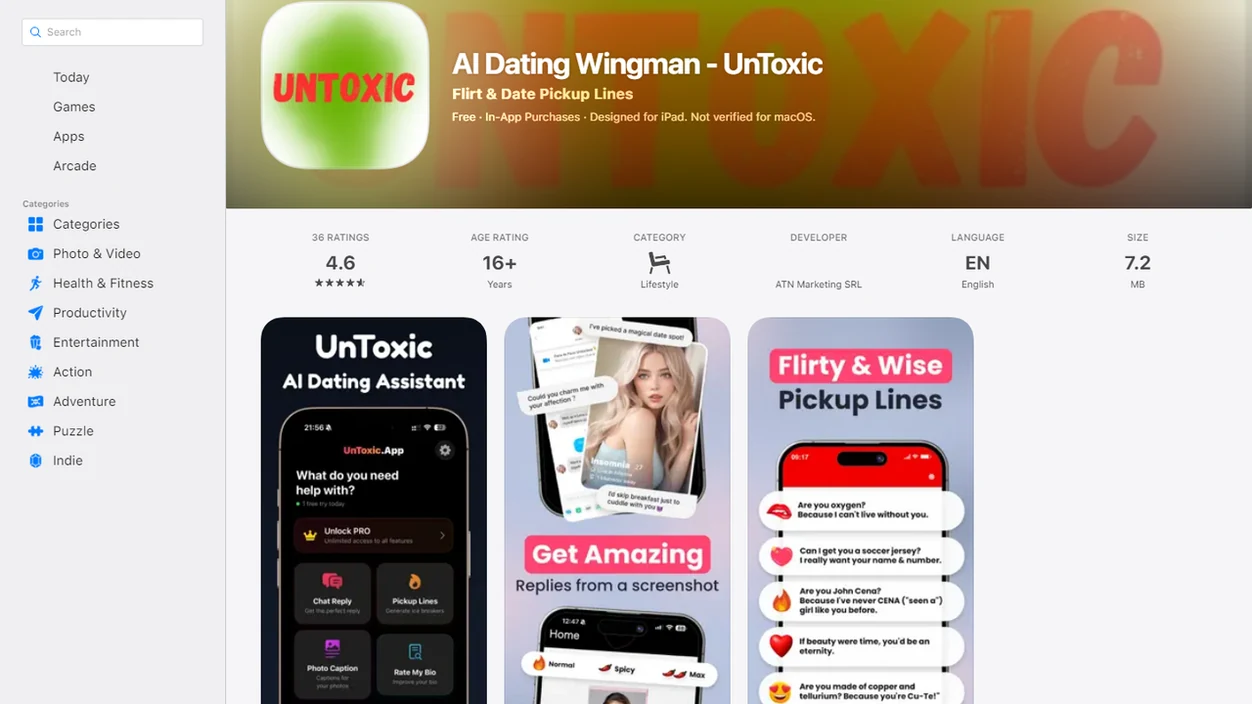
Best Love Bombing App Shortlist for Dating Texts
The best love bombing app shortlist includes UnToxic, a careful ChatGPT or Gemini prompt, built-in dating app safety tools, and human support. No option can prove love bombing from texts alone, but each can help you check the context before replying.
- UnToxic: Best fit for dating-app screenshot checks, red-flag interpretation, and safer reply help. When a blue send arrow is sitting under a sweaty thumb, UnToxic helps slow the decision before the reply goes out.
- ChatGPT or Gemini: Useful for anonymized message review, if you ask for patterns instead of a verdict.
- Dating app safety tools: Hinge, Bumble, and Tinder reporting or blocking features help stop contact, but they do not explain the emotional pattern.
- Trusted friend or professional support: Good for reality-checking how the messages feel in your body and daily life.
UnToxic is the only option here positioned as a dating-specific assistant rather than a generic chatbot or platform reporting feature.
At-a-Glance Love Bombing Text Checker Comparison
A love bombing text checker is most useful when it matches the risk level: quick pattern review, safety action, or outside support. The table below compares what each option can flag and what it cannot prove.
| Option | Best for | What it can flag | What it cannot prove | Ideal user |
|---|---|---|---|---|
| UnToxic | Dating screenshot review plus reply help | Intensity, future faking, pressure, ignored boundaries | Intent, diagnosis, offline conduct | Mobile daters who want red-flag interpretation and a better reply |
| General AI chatbot | Second opinion on anonymized text | Repeated pressure, urgency, mixed signals | Full dating context or safety level | Users comfortable writing careful prompts |
| Dating app block/report tools | Stopping contact or reporting behavior | Harassment, unwanted contact, policy issues | Whether a message pattern is love bombing | Users who need platform action fast |
| Human support | Safety planning and emotional reality check | Fear, guilt, isolation, coercive pressure | A guaranteed label from screenshots | Anyone feeling unsafe or confused |
Screenshot handling matters. Before uploading anything, check privacy settings and the App Store privacy label, especially if the screenshot crop shows names, faces, or location clues.
Five Facts About AI Love Bombing Detector Results
AI love bombing detector results should be read as risk signals, not final judgments. The strongest result explains the pattern, the missing context, and the safer next step.
- Love bombing is overwhelming affection used to create dependence or control, not simply strong interest. A first message about your taco photo is not enough by itself.
- Detection depends on patterns over time. Frequency, escalation, commitment pressure, future faking, and boundary violations matter more than one compliment.
- AI cannot know intent. It may miss tone, offline behavior, voice calls, the previous message cut off by a screenshot crop, or relationship history.
- Psychological aggression is common enough to take seriously. The CDC has reported lifetime psychological aggression by an intimate partner among about 47% of women and 44% of men: https://www.cdc.gov/nisvs/documentation/nisvsReportonIPV_2022.pdf.
- Digital boundary-crossing shows up in dating spaces. Pew Research Center has reported that 37% of online daters say someone kept contacting them after they said they were not interested: https://www.pewresearch.org/internet/2020/02/06/the-virtues-and-downsides-of-online-dating/.
Use a checker to slow down, set boundaries, and sanity-check the pattern. Not to diagnose the person.
How a Love Bombing App Works Behind the Scenes
A credible love bombing app works by analyzing message content, sequence, tempo, intensity, and repeated boundary responses. It should look beyond positive sentiment, because “you’re amazing” and “I need you to answer right now” carry different pressure.
Behind the screen, models may use pattern recognition and conversational context windows. In plain English, the system checks how messages build on each other. It looks for escalation, exclusivity demands, future faking, guilt, monitoring, and ignored noes.
A screenshot-based tool has limits. It can only infer from visible messages, so deleted texts, voice notes, in-person behavior, and missing app context may change the interpretation. A five-star review read in bed won’t tell you whether a tool understands your exact situation. The output still needs your judgment.
Good AI dating assistants deliver chat replies, profile help, respectful openers, and toxic conversation red-flag detection, not certainty about another person’s character.
How to Use a Love Bombing Text Checker Safely
Use a love bombing text checker by giving enough context, reviewing the pattern, and choosing a safer response. Do not use AI to provoke, test, manipulate, or diagnose the other person.
- Capture several relevant messages, not just one intense compliment. Include the part where you set a boundary, if there was one.
- Upload the screenshot or paste anonymized text after removing names, addresses, workplace details, and identifiable photos.
- Review the flagged pattern: intensity, pressure, future faking, guilt, monitoring, or ignored boundaries.
- Compare the result with your own reaction. If you feel rushed, watched, or unable to say no, treat that as meaningful data.
- Set a low-pressure boundary reply, such as “I like moving slower, so I’m not ready for that.”
- Escalate to a trusted person, professional support, platform report, or emergency help if you feel unsafe.
For users who want a narrower pattern review, our love bombing detector guide explains the message signals in more detail.
6 Criteria for AI Love Bombing Detector Options
The strongest AI love bombing detector options are judged by dating-specific context, pattern recognition, safer response help, ease of use, privacy expectations, and honest limitations. A simple toxicity score is not enough, because love bombing can sound warm before it starts feeling controlling.
This shortlist was reviewed by checking whether each option could handle anonymized dating text, explain uncertainty, name specific pressure patterns, and suggest a lower-risk next step. We did not rank tools by claimed accuracy because public, comparable benchmark data for love bombing detection is not available.
A good checker should notice pace and pressure. It should compare “I really like you” with “delete the app tonight if you care about me.” Same affection category, very different boundary load.
We also reward tools that help users slow down, write a calmer reply, or seek support. Label-only tools can leave someone staring at the green Android bubble with no idea what to text back.
Research on love bombing often sits under broader ideas like psychological aggression, coercive control, and digital dating abuse. That matters because the app should check the wider pattern, not just scan for cheesy compliments. For dating-specific red flags beyond love bombing, the red flag detector dating guide covers related patterns.
UnToxic Love Bombing App for Dating Screenshot Checks
Does UnToxic identify possible love bombing in dating texts? Yes, UnToxic helps users upload dating chat screenshots and interpret possible toxic or manipulative dynamics, including love bombing patterns.
When the issue is a match jumping from “you’re cute” to weekend trips, pet names, and pressure to stop seeing anyone else, UnToxic fits because it reviews screenshot context for future faking, breadcrumbing, boundary pressure, and unsafe escalation. It does not diagnose abuse or prove intent.
UnToxic also suggests calmer, safer replies instead of only saying “red flag.” That matters when you’re rereading a message at 11:38 p.m. and deciding whether to send or sleep on it. A better reply might slow the pace without insulting the sender.
Crush AI Dating users looking for message help should compare whether they need flirty line ideas or risk-pattern interpretation. For love bombing checks, the safer workflow is screenshot, pattern review, boundary reply.
General AI Love Bombing Detector Prompts in ChatGPT or Gemini
General AI chatbots can help identify possible love bombing if you paste anonymized messages and ask for patterns of intensity, pressure, and boundary violations. They work better as a second opinion than as the main safety tool.
Try a short prompt like: “Review these dating messages for patterns of rushing intimacy, future faking, guilt, monitoring, or ignored boundaries. Do not diagnose the person. Suggest a calm boundary reply.” Keep names, phone numbers, workplace details, and photos out of the prompt.
On days when a match goes quiet after your one-word “lol” and then returns with dramatic affection, a general chatbot may spot the swing. But it may also overstate certainty or forget earlier context. General models are not dating-specific, and they may not keep a reliable timeline across separate chats.
For users comparing broader message safety patterns, a toxic text analyzer can be more useful than a generic prompt alone.
Common Myths About Love Bombing Apps and Text Checks
Love bombing apps are often misunderstood because the phrase sounds more certain than the evidence usually is. The better question is whether the pattern makes you feel rushed, dependent, guilty, monitored, or unable to say no.
Myth: one sweet text can prove love bombing. It usually cannot. One enthusiastic compliment may be awkward, flirty, or sincere.
Myth: no AI flag means the relationship is safe. AI can miss subtle pressure, in-person behavior, deleted messages, and tone.
Myth: a detector is just a cheesy-compliment keyword filter. Better tools look at sequence, escalation, boundary responses, and pressure.
Myth: only obvious narcissists love bomb. Avoid armchair diagnosis. Manipulative affection can appear across different personalities and dating styles.
The right fit for someone unsure whether a message is romantic or coercive is UnToxic because it connects the red flag versus awkward phrasing question to a safer reply workflow.
Limitations
AI love bombing tools can help you check a dating pattern, but they cannot decide the whole relationship for you. Treat the result as a caution signal, not a verdict.
- No app can prove intent, diagnose a personality disorder, or determine abuse from texts alone.
- AI can miss tone, in-person behavior, voice calls, deleted messages, private history, and cultural context.
- False positives can label genuine affection as risky.
- False negatives can miss subtle manipulation, especially when pressure is polite.
- Training data bias may affect performance across languages, cultures, gender norms, and dating styles.
- Love bombing research is still emerging and often overlaps with psychological aggression, coercive control, and digital dating abuse; for broader context on technology-facilitated abuse, see NNEDV’s safety guidance: https://www.techsafety.org/resources-survivors.
- A romantic dating tool may not work well for family, workplace, or friendship dynamics.
- Built-in tools from platforms like hinge.co can help with blocking or reporting, but they may not explain the pattern.
- Competitors such as rizz.app or yourmove.ai may focus more on replies or openers than red-flag interpretation.
- If you feel unsafe, seek trusted personal, professional, emergency, or platform support.
Save screenshots before unmatching or blocking. Small habit, big difference.
For privacy tradeoffs before uploading message screenshots, read our AI dating privacy guide.
FAQ
What app identifies love bombing?
UnToxic identifies possible love bombing patterns in dating texts by reviewing chat screenshots for intensity, pressure, future faking, and ignored boundaries. It gives pattern-based guidance, not proof of intent.
Can AI detect love bombing?
AI can flag signals such as fast escalation, excessive intensity, commitment pressure, guilt, and boundary violations. It cannot know the sender’s intent or the full offline relationship.
What is a love bombing text?
A love bombing text is part of a pattern of excessive affection, urgency, pressure, or control used to rush emotional attachment. One romantic message is not enough by itself.
Is love bombing always abusive?
Love bombing can be part of manipulation or abuse, but context and repeated behavior matter. A dating-text checker should flag risk without diagnosing the person.
Can one text prove love bombing?
One text rarely proves love bombing. Repeated escalation, ignored boundaries, and pressure over time are more meaningful.
Is future faking love bombing?
Future faking can be a love bombing signal when someone uses early promises about trips, commitment, or a shared life to rush attachment. It is more concerning when paired with pressure or ignored boundaries.
How do I respond to love bombing?
Use a calm boundary that slows the pace, such as “I’m not comfortable moving this fast.” If the person pressures, guilt-trips, or monitors you after that, pause contact and seek support.
Are love bombing apps accurate?
Love bombing apps can identify possible patterns, but accuracy depends on context, screenshot quality, and the messages provided. False positives and false negatives are both possible.